Imagining Tomorrow: How Societies Rehearse the Future Through Speculative Storytelling
A film by Don Schechter
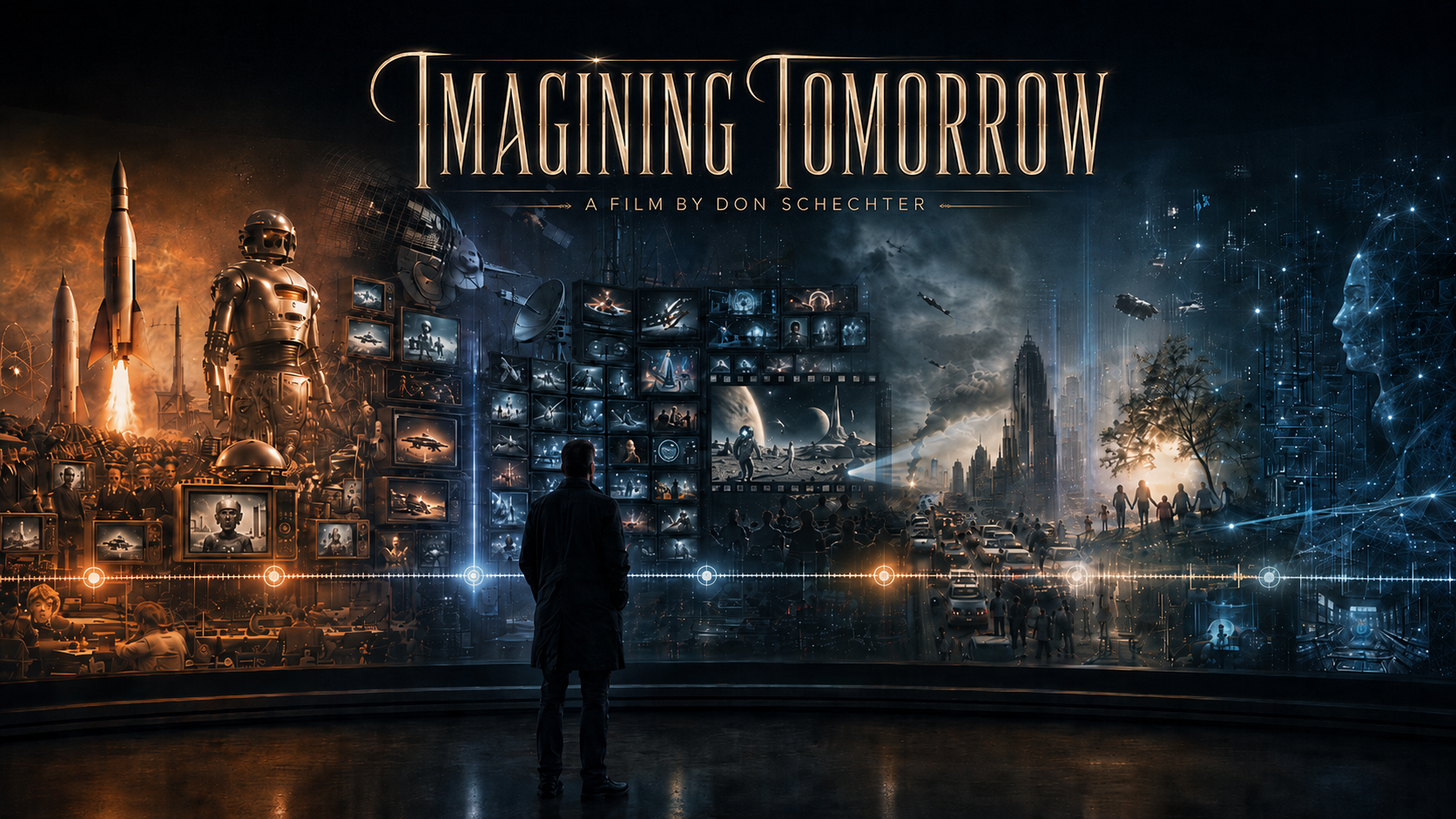
About the film:
Long before a technology reshapes everyday life, societies begin to imagine it. Before artificial intelligence entered our workplaces, before algorithms began curating what we see and believe, before the question of who controls the machines became one of the defining political questions of our time, science fiction was already rehearsing the answers.
Imagining Tomorrow is a feature-length documentary that examines over seventy years of science fiction film and television as something more than entertainment. It asks a question that feels newly urgent: if societies rehearse the future through stories, what do those stories reveal about what we feared, what we hoped for, and who we believed would be left holding the controls?
The film traces how speculative storytelling has tracked the great anxieties of each era. In the 1950s, the fear was nuclear annihilation and the loss of individual identity to faceless conformity. By the 1970s and 1980s, technology had begun to feel less like a tool and more like a system with a will of its own. In the 1990s, stories about conspiracy, surveillance, and the unreliability of reality itself reflected a growing suspicion that the institutions organizing modern life had grown too complex to understand and too powerful to challenge.
As the century turned, Y2K briefly made the machinery of modern civilization itself the villain, and when the clocks rolled over without catastrophe, the relief was short-lived. After September 11, the nostalgia that had softened earlier science fiction gave way to something harder: stories about survival, moral compromise, and imagining life inside the apocalypse rather than before it. Battlestar Galactica, The Walking Dead, and Children of Men were not warnings about the future. They were reckonings with a present that already felt broken. By the late 2000s and into the 2010s, a quieter shift was underway. The genre increasingly turned toward questions of meaning, belief, memory, and what survives catastrophe when science alone cannot explain the human need for hope.
Today something new is underway. As artificial intelligence reshapes communication, labor, creativity, and knowledge itself, speculative stories are asking not whether new technologies will work, but who will govern them, who will benefit, and what happens to everyone else. Contemporary science fiction is less concerned with the robot uprising than with something quieter and more unsettling: the gradual transfer of authorship, judgment, and power to systems no single person controls and few fully understand. The fear is not that the machines will turn on us. It is that we will hand them the keys willingly, and only later think to ask whose interests they were built to serve.
Imagining Tomorrow draws on a research database of more than 1,300 science fiction films and television series produced since 1950 to investigate whether these shifts represent a pattern, and what that pattern might tell us about the present moment. The film brings together historians, media scholars, philosophers, and cultural critics to explore how speculative storytelling has served as one of humanity's most enduring ways of confronting what it cannot yet name.
Imagining Tomorrow is being developed by Charles River Media, Inc. with guidance from a humanities advisory board of scholars, historians, and cultural critics.