The Last Yztari
A film by Tim O'Donnell
About the project:
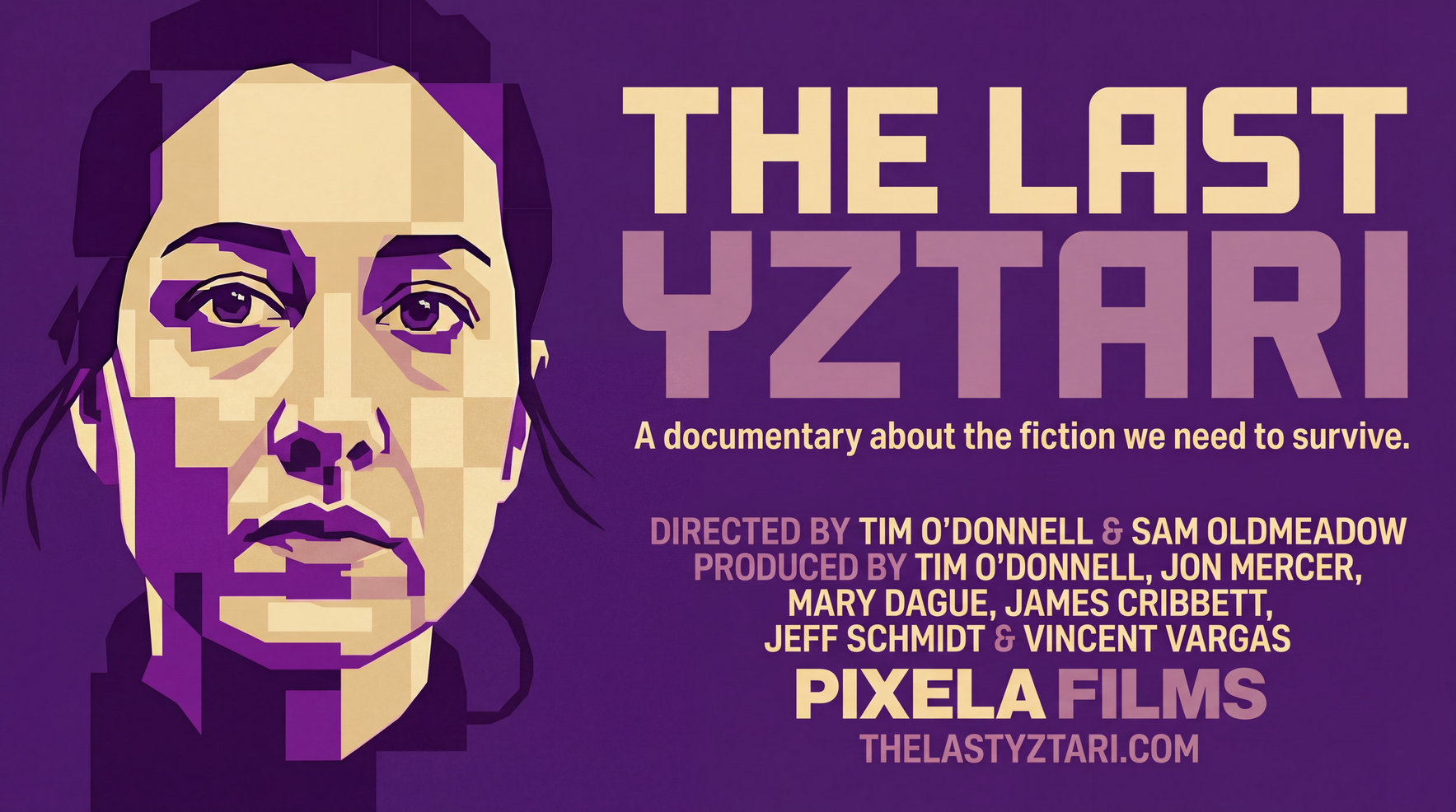
Mary Dague lost both arms defusing bombs in Iraq. She tried for years to write her story and couldn't. Eighteen years later, she's building a world where that trauma belongs to someone else—narrated by DANI, the artificial consciousness she created to watch over her fictional selves. The film reveals her rebuilding identity through imagination, and asks what happens when the only way to tell the truth is through fiction.
"The Last Yztari" is an innovative hybrid documentary that explores the complex terrain of trauma recovery through the lens of fantasy, digital identity, and narrative reconstruction. The film follows Mary Dague—a double-arm amputee, gamer, writer, and survivor of childhood sexual abuse—as she navigates the liminal spaces between physical embodiment and virtual existence, using storytelling as a mechanism for psychological survival and self-determination.
At the film's conceptual core lies Mary's decade-long science fiction novel, "The Last Yztari," which functions as both creative outlet and therapeutic framework. Through richly stylized animation, the novel's protagonist Xia—a genetically engineered guardian with fractured memory and severed identity—emerges as a profound metaphor for dissociation, recovery, and the reconstruction of selfhood after trauma. The parallel narratives of Mary and Xia create a dialogue between lived experience and imaginative processing, examining how fantasy serves as both escape mechanism and integrative tool.
The documentary's visual architecture is deliberately hybrid and layered, employing multiple iterations of AI-generated imagery to reflect the evolving relationship between human consciousness and digital representation. Observational sequences from Mary's daily life dissolve into virtual gaming landscapes and animated sequences, creating a fluid visual grammar that mirrors the protagonist's navigation between different modes of being. These aesthetic choices challenge traditional documentary form while reflecting contemporary questions about embodiment, presence, and authentic selfhood in digital spaces.
Central to the film's exploration is Mary's relationship with her husband James, himself a gamer and caretaker. Their dynamic becomes increasingly complex when James returns from deployment with his own psychological wounds, transforming Mary from care recipient to caregiver. This role reversal illuminates the film's broader investigation into interdependence, emotional labor, and the ways couples negotiate shared trauma while maintaining individual agency. The gaming community that both inhabit serves as a crucial third space where traditional power dynamics are suspended and alternative forms of intimacy and leadership can emerge.
Mary's online identity as "Wonder Nubs" represents a radical reclamation of agency and humor in the face of societal marginalization. Within gaming environments, her physical disability becomes irrelevant, allowing for expressions of competence, leadership, and community that are often denied in physical spaces. The film examines how digital avatars function as sites of empowerment and authentic self-expression, particularly for individuals whose bodies have been marked by trauma or difference.
The documentary's treatment of multiple characters processing various traumas through different relationships with AI and digital representation creates a broader meditation on contemporary survival strategies. Through Mary's interactions with generative AI tools in her creative process, the film explores how emerging technologies might serve as collaborators in meaning-making and narrative reconstruction for trauma survivors.
The work challenges conventional representations of disability, resilience, and recovery by refusing inspirational frameworks in favor of complex, contradictory portraiture. Mary emerges not as symbol but as artist—someone who has constructed elaborate internal and external worlds that enable not merely survival but creative flourishing. The film interrogates how we define wholeness, agency, and authentic selfhood when traditional markers of these concepts have been disrupted.
"The Last Yztari" ultimately raises fundamental questions about the nature of identity construction in an increasingly digital age: How do we maintain coherent selfhood across multiple platforms and realities? What role does imagination play in trauma recovery? How might virtual spaces offer possibilities for being that physical spaces foreclose?
Mary's military service as an Army Explosive Ordnance Disposal technician in Iraq, where she lost both arms in an improvised explosive device explosion while protecting a school, provides the historical context for her journey. However, this experience of war and its aftermath serves as departure point rather than defining narrative, allowing the film to explore the ongoing creative work of rebuilding identity and meaning in civilian life.