Pieces of Beethoven
A film by Sheila Hayman
About the project:
PIECES OF BEETHOVEN:
featuring, Steven Isserlis, Gabriela Montero, Steven Osborne and the Kammerphilharmonie Bremen with Paavo Järvi
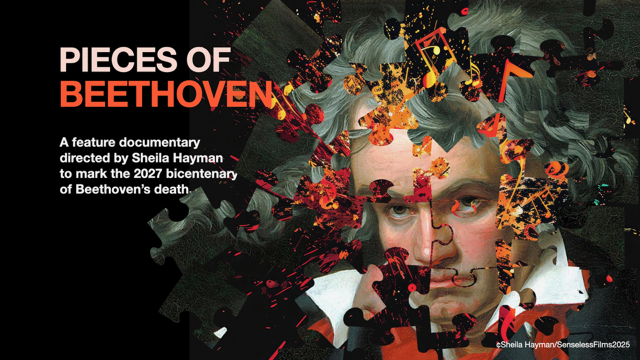
Two hundred years ago Beethoven died, and fans and scavengers descended, looking for souvenirs. Our film for the bicentenary starts with his death, and discovers how the scattered fragments of his manuscripts (and hair) are being reassembled and deciphered, through a magical marriage of dedicated scholarship and brand-new technology. The story circles around his Eroica Symphony, written at a moment of great crisis, and cementing his reputation as the first, and greatest, artist hero of Western music.
When Beethoven dies in March 1827, he's the most famous musician in Europe, and worshippers flock to pay homage - with scissors. Three days later, he's completely bald; everyone wants a piece of him.
His celebrity arises from the time and place, as well as his talent. Beethoven bursts on the scene as the Enlightenment is set on fire by French revolutionary ideas. As Napoleon approaches, German Romanticism is born, and with it the idea of the artist creator, the bridge between mortals and God. Beethoven is the perfect embodiment of this; unlike most of his predecessors, writing to order as servants of the nobility, Beethoven declares that his talent makes him the equal of any aristocrat. He writes what he wants, when he wants - and then invites patrons to pay for it.
So, he can spend months, or years, working and reworking a single piece; and all those notes and ideas are in a vast hoard of musical sketchbooks, which he cherishes and takes with him on his frequent moves around Vienna (he's a noisy, alarming and unpopular neighbour). When the sketchbooks and manuscripts are scattered at Beethoven's death, the secret of his genius vanishes too. But today, forensic science, musical detective work and passionate perseverance are putting the pieces back together.
The first challenge is to locate these scattered pages and then fit them together in the right order. Without dates or page numbers, and given the unintelligible scrawl of Beethoven's handwriting, Julia Ronge at the Beethoven-Haus shows us how ink colours, quill shapes and even matching blotches serve as clues. Beethoven's moods and moments of inspiration are also revealed: a whole page replaced by a single bar, or entirely scribbled over, not from bad temper but a determination to get it right.
Meanwhile, what of the hair? Locks of 'Beethoven's Hair' have been cherished and passed down through generations. Tristan Begg, a young Beethoven obsessive, reads the Heiligenstadt Testimony, in which Beethoven pours out his despair at his failing hearing, and his hopes that one day, doctors will find out why he suffers so badly with his health.
Tristan happens also to be a palaeogeneticist, working in the lab where the Neanderthal genome has just been sequenced, using ancient tissue fragments. Tristan realises that he may be able to do the same for Beethoven and fulfil his hero's wish, using those carefully guarded scraps of hair. But when he manages to assemble four of them and finally analyses their DNA - they're all different. Only one, if that, is Beethoven's; but how to find out which one? Tristan thinks his years of work are wasted. Only long walks listening to Beethoven's music comfort him.
The music he listens to is the Third (Eroica) Symphony, written just after the Heiligenstadt Testimony: the composer's blazing refusal to accept his fate, tearing up the musical rules as he does so.
Alan Gosman and Lewis Lockwood have spent twenty years deciphering the sketchbook for this symphony. What they find is an extraordinary record of Beethoven's work over years, not just on this one piece but also the famous opening of the Fifth Symphony - and the odd commercial crowdpleaser, knocked out when funds are running low.
They show us Beethoven getting more and more excited as he finds new possibilities in the music, his handwriting speeding up and his crossings-out wilder, as he realises that deafness is not going to destroy him, but may actually be the making of him.
We hear this from Paavo Järvi and the Deutsche Kammerphilharmonie Bremen orchestra, showing us Beethoven at work, trying out different versions of the great fanfare that announces the final movement.
But what comes then? A whispered tune, so simple it can be plucked on a violin string.
Gosman and Lockwood show us where this tune began; in a piano theme and variations, which Beethoven developed through his favourite party trick of improvising at the piano. He was even more famous as an improviser than a composer in his life; but with no means of recording, most of his improvisations have been lost.
Today's greatest improvising composer is Gabriela Montero, who can instantly turn any pop song or advertising jingle into a complex masterpiece; we watch and listen to her meeting Beethoven's theme and variations for the first time and adding her own twist to it.
And unlike Beethoven, Gabriela has the benefit of modern technology: she shows us how a computer records and transcribes every note she improvises, for her to refine into a new work.
Meanwhile, Tristan has managed to get hold of another, authenticated lock of Beethoven's hair, which he can compare with the others; his project has a pulse again. It matches one of the previous four, so now he's sure he's got Beethoven's DNA. He finds a tendency to liver disease and a Hepatitis B infection, explaining Beethoven's final illness.
He also finds very high levels of lead, that may have contributed to Beethoven's still unexplained deafness. Why? The answer lies in the 'conversation books' Beethoven used to communicate when he could no longer hear what people said to him. There are 139 of these, a random jumble of chat, shopping lists, notes to himself and scraps of music, which have taken decades not just to transcribe, but also turn into sense. But one thing comes up a lot; Beethoven's fondness for sweet Hungarian wine. And it was sweetened, as wine had been since Roman times, with lead.
Tristan has now found a new lock of hair, dating from the time when Beethoven's deafness became impossible to ignore. We find out what he discovers.
Steven Isserlis is famous for his hair. He says he had it cut, once: never again. He's also one of the world's top cellists. Beethoven didn't write much cello music, so Steven takes us to Beethoven's birthplace in Bonn and shows us, with musicologist and pianist Professor Robert Levin, how the few sonatas he did write are like snapshots of the different stages of his life.
By the time Beethoven goes to work on his final piano masterpiece, the 'Diabelli' Variations, he's old and ill, in constant pain. Julia Ronge shows us in the sketchbook how slowly he is now working, and how much less confident of his first ideas; the sketchbook is full of notes not just crossed out but scratched completely away with a knife, to make sure only the right version gets to the printer.
And in between, there are scribbles in different pens and in red chalk, notes to himself - it's a total mess. But somewhere in here is the ageing Beethoven, working not just on this piano piece but also the work that cemented his fame, the 9th Symphony. How to make sense of it, to get into his head?
Once again, technology comes to the rescue; Susanne Cox and Johannes Kepper at the 'Beethovens Werkstatt' project have pioneered software that analyses and separates each different musical idea, sometimes dozens on a single page. She shows us a scribble magically morphing into notes, and then the finished sketch. And then we see and hear the magnificence of the finished Diabelli Variations, one of the most challenging works in the piano repertoire, performed by international virtuoso Steven Osborne - one moment lyrical, the next as radical as Steven's other great love, modern jazz.
There's another mystery in the Diabelli sketchbook: fingerings. Beethoven always made sure there was a piano wherever he went, even after he lost his hearing. Why would he have needed a piano, when he was already completely deaf?
David Ginty has an explanation: he runs the neuroscience lab at Harvard, and he's recently discovered that certain kinds of touch are processed together with hearing, in the brain, Beethoven could have heard through his hands.
Tristan's final discovery is the most startling. When he first sequenced Beethoven's DNA he took samples from the van Beethovens living today - and found they were totally different in the male line. Beethoven wasn't a Beethoven. The others, whose identities rest on this relationship, are understandably devastated. But recently Tristan tracked down somebody alive today whose DNA is almost identical to Ludwig's. Exclusively for this film, he's about to find out who Beethoven really was.
We end the film with the orchestra performing the barnstorming finale of the Eroica, having watched and listened to it developing under Beethoven's hands and in his head, through sketchbooks, improvisations, and the final corrected copy sent to the publishers.
Famously, Beethoven scrubbed out his original dedication, to Napoleon, and just called it 'Eroica' - 'Heroic'. It's a fitting description of Beethoven himself, struggling and persevering, checking every note and marking until he's satisfied.
But the other heroes of this story are the musicians and scholars who dedicate years, or decades, of their lives to the painstaking collecting and deciphering of scattered documents.
We live in an age where digital technology has made the traces of our lives evanescent; no postcards, letters, notebooks, pictures - just binary code that vanishes as quickly as it appears. Yet these scraps of paper have survived for two centuries; and, properly read, they show us why Beethoven still towers above all other composers and transport us right into the head of Western music's greatest genius, hearing his music as never before.